
This time we’re looking at the dive sites around Kurima Island and Miyako Island’s south coast.
This is the area you dive on rough midwinter days when strong northerlies put Irabu Island and Shimoji Island out of reach.
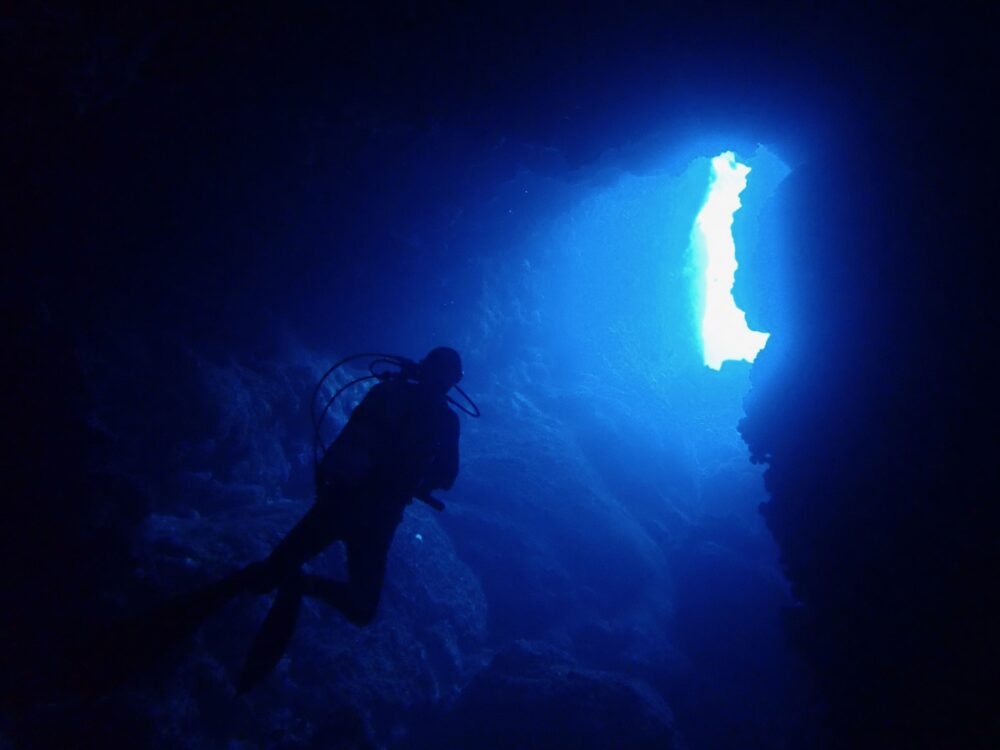
Led by Ushisan Kowaiyo, a cave that runs more than 40m, the rock formations here have a character all their own — quite different from Irabu Island and Shimoji Island.
Kurima Island and the south coast also have shore-entry sites, which makes the area a good fit for try dives and beginners.
This article covers 16 boat sites and 4 shore-entry sites — 20 in all.
What makes the Kurima Island and south coast area special

The south coast area runs along the southern shore of Miyako Island, from Kurima Island out to Higashi-Hennazaki Cape.
The character of this area comes down to these three points.
| Feature | Details |
|---|---|
| The area you dive on northerly winter days | It catches the days when Irabu Island and Shimoji Island are too rough |
| Shallow, bright terrain | Caves and arches sit in shallow water, so beginners can enjoy the terrain |
| Shore entries are possible | Kurima Beach, Shigira Beach and others can be entered from land |
The area that comes into its own on northerly winter days
Diving on Miyako Island centers on Irabu Island when the wind is southerly and Shimoji Island when it’s northerly.
But in midwinter, when strong northerlies whip up the sea, even Shimoji Island becomes unreachable on some days.
That’s when this area, on the south side of the island, comes into play.
Put another way, it’s the area that rescues the dive you’d otherwise have written off to bad weather.
Shallow, bright terrain
The terrain around Irabu Island and Shimoji Island is deep, with most sites aimed at intermediate divers and above.
The terrain sites here, by contrast, sit in shallow water, so beginners can enjoy arches and caves too.
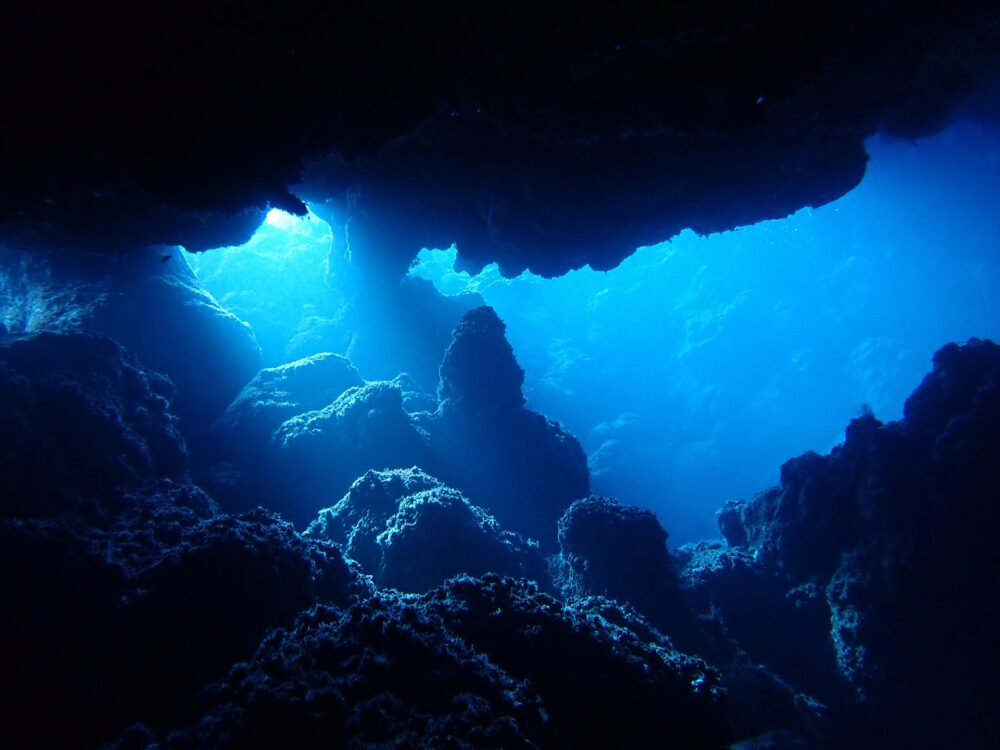
Because it’s shallow, light reaches easily, and the beams inside the caves show up clearly — another strength of the area.
| Terrain | Typical depth | Representative sites |
|---|---|---|
| Caves | Up to 23m | Ushisan Kowaiyo / Angel Cave |
| Arches | 3–25m | Nanamata Arch / Gao |
| Holes | 5–18m | Ushisan Arigatou |
| Coral and sand | 5–30m | Coral Garden / Muiga |
Sites you can enter from the beach
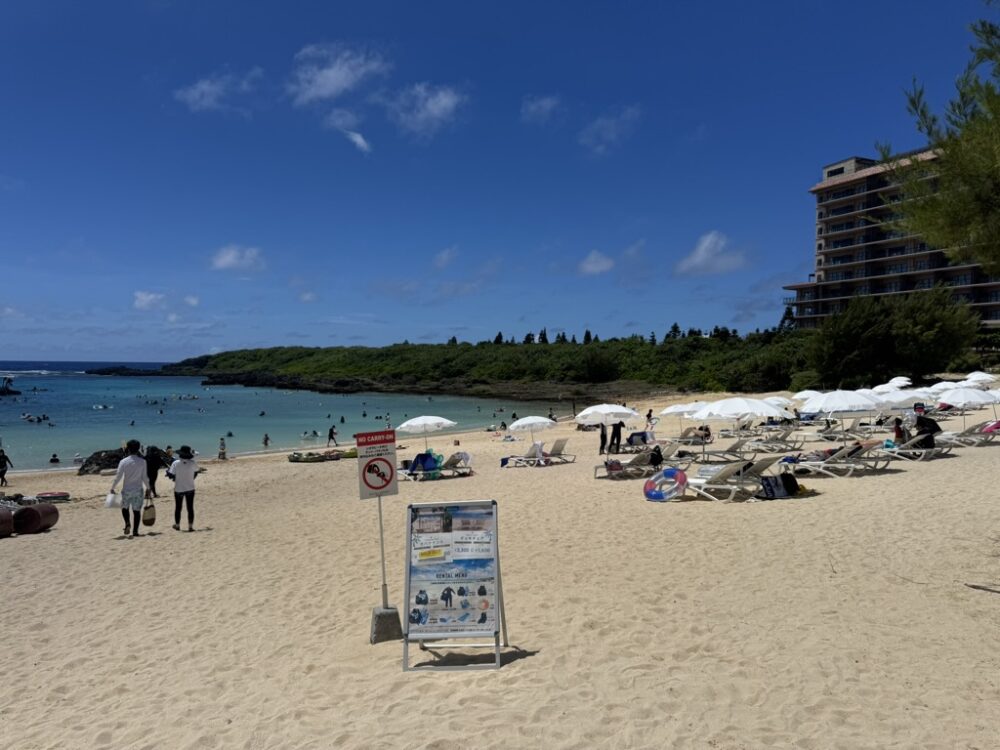
Kurima Island and the south coast have sites you can enter from shore.
All of them are shallow, between about 4m and 7m, and are often used for try dives and certification courses.
Being able to dive even on days when boats can’t run is a strength unique to this area.
| Dive site | Depth | Highlights |
|---|---|---|
| Kurima Beach | Up to 6m | Clownfish |
| Hakuai WaiWai Beach | Up to 5m | Sea turtles |
| Shigira Beach | Up to 4m | Green sea turtles |
| Imgyaa Marine Garden | Up to 7m | Tomato anemonefish, calm water |
Boat dive site list
Here are the 16 sites reached by boat.
If you’d like the overview first, start with the table below.
| Dive site | Depth | Level | Highlights |
|---|---|---|---|
| Muiga | 5–30m | Intermediate | Coral gardens, from critters to big animals |
| Gao | 3–25m | Intermediate | Terrain through arches and crevices |
| Ushisan Kowaiyo | Up to 23m | Beginner | A cave running more than 40m |
| Ushisan Arigatou | 5–18m | Beginner | A sunlit chimney, fish in the shadows |
| Nanamata Arch | Up to 16m | Beginner | Several arches, a freshwater spring deep in the cave |
| Angel Cave | Up to 12m | Beginner | A curtain of light |
| Coral Garden | Up to 8m | Beginner | Coral spreading across the shallows |
| Labyrinth | — | Intermediate | A maze of connecting crevices |
| No.5 Arch | — | Beginner | An arch plus a cave in the offshore rock |
| No.11 Hole | — | Intermediate | A chimney known as the mini Devil’s Palace |
| Ingama Coral | — | Beginner | A wide variety of coral |
| Hama Paradise | Up to 7m | Beginner | Sand flats rich in anemonefish |
| Diana | Up to 25m | Beginner | Vast sand flats dotted with bommies |
| Small World & Garden Garden | Up to 30m | Beginner | Two bommies, a coral panorama |
| Yoshino Reef | — | Beginner | A shallow reef off Yoshino Beach |
| Panari to Panari | Up to 28m | Advanced | Schooling pelagics, manta rays if you’re lucky |
*Depths and levels vary by shop and course. Always check with your dive shop before booking.
Muiga
| Depth | 5–30m |
| Level | Intermediate |
| Current | Occasional |
| Highlights | Coral gardens, from critters to big animals |
Muiga is a site off Muiga Cliff in southeastern Miyako Island.
It sits right beside the Nanamata Coast that the cliff looks down on, and is often dived together with Nanamata Arch in the same area.
Coral gardens spread across the bottom, and there’s everything from tiny critters to big animals.
Depths reach 30m, so leave yourself margin on depth and air.
Gao
| Depth | 3–25m |
| Level | Intermediate |
| Current | Occasional |
| Highlights | Terrain through arches and crevices |
Gao is a site where you swim through arch formations and crevices.
It runs from 3m in the shallows down to 25m, giving the biggest sense of terrain anywhere on the south coast.
Ushisan Kowaiyo
| Depth | Up to 23m |
| Level | Beginner |
| Current | Rarely |
| Highlights | A cave running more than 40m |
Ushisan Kowaiyo (“Mr. Cow, I’m scared”) has a cave more than 40m long — one of the longest cave sites on Miyako Island.
It’s one of the “Ushisan series” of sites, named because divers used a cow statue on the nearby shore as a landmark.
The tunnel is pitch dark all the way through, so a light is essential. That said, it’s wide inside and not especially demanding as terrain goes.
Inside you’ll find crustaceans such as banded coral shrimp and dancing shrimp, and the ethereal light through the exit is another highlight.
Because of the distance involved, go in with plenty of air in reserve.
Ushisan Arigatou
| Depth | 5–18m |
| Level | Beginner |
| Current | Rarely |
| Highlights | A sunlit chimney, fish in the shadows |
Ushisan Arigatou (“Thank you, Mr. Cow”) lies a little to the west of Ushisan Kowaiyo.
The story goes that divers found their way here using a cow statue on the shore nearby, and the name is a thank-you to that cow.
Follow the tunnel from a crevice between two bommies and you come out into a chimney with daylight pouring down from above.
Inside you’ll find black jack, and bluefin trevally around the entrance. Near the cave mouth there are also stingfish and large harlequin sweetlips.
With almost no current and fairly shallow water, you can take the terrain at a relaxed pace.
Nanamata Arch
| Depth | Up to 16m |
| Level | Beginner |
| Current | Rarely |
| Highlights | Several arches, a freshwater spring deep in the cave |
Nanamata Arch sits offshore from the sheer cliffs of the Nanamata Coast. You drop into the opening at around 6m and swim through a series of arches.
Deep in the cave there’s a freshwater spring, where you can see the chemocline formed as fresh water meets seawater.
Light comes in through a number of openings, which also makes it a great site for photos.
Angel Cave
| Depth | Up to 12m |
| Level | Beginner |
| Current | Occasional |
| Highlights | A curtain of light |
Angel Cave is a cave site beneath the reef off Higashi-Hennazaki Cape.
A cave roughly 20m long twists and turns like a maze, with passages linking up in complex ways.
There are four chambers in the middle, where sunlight falls through gaps in the reef overhead.
That light looks just like an angel descending, which is how the site got its name.
The light shifts between white, emerald green and blue. It shows up best during the day, especially at low tide.
You’ll also see blennies, damselfish and Napoleon wrasse here.
Coral Garden
| Depth | Up to 8m |
| Level | Beginner |
| Current | Rarely |
| Highlights | Coral spreading across the shallows |
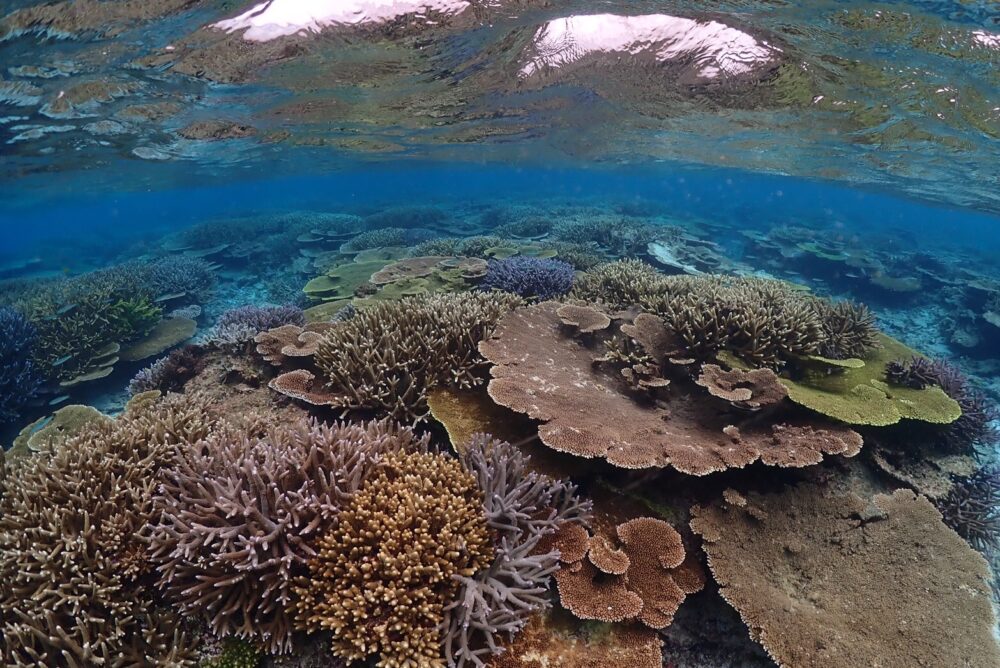
Coral Garden is a shallow site south of Kurima Island, at around 8m.
At a maximum of 8m with almost no current, beginners can dive it with complete confidence.
All kinds of coral spread across the bottom, drawing butterflyfish, damselfish and anemonefish.
Labyrinth
| Depth | — |
| Level | Intermediate |
| Current | Occasional |
| Highlights | A maze of connecting crevices |
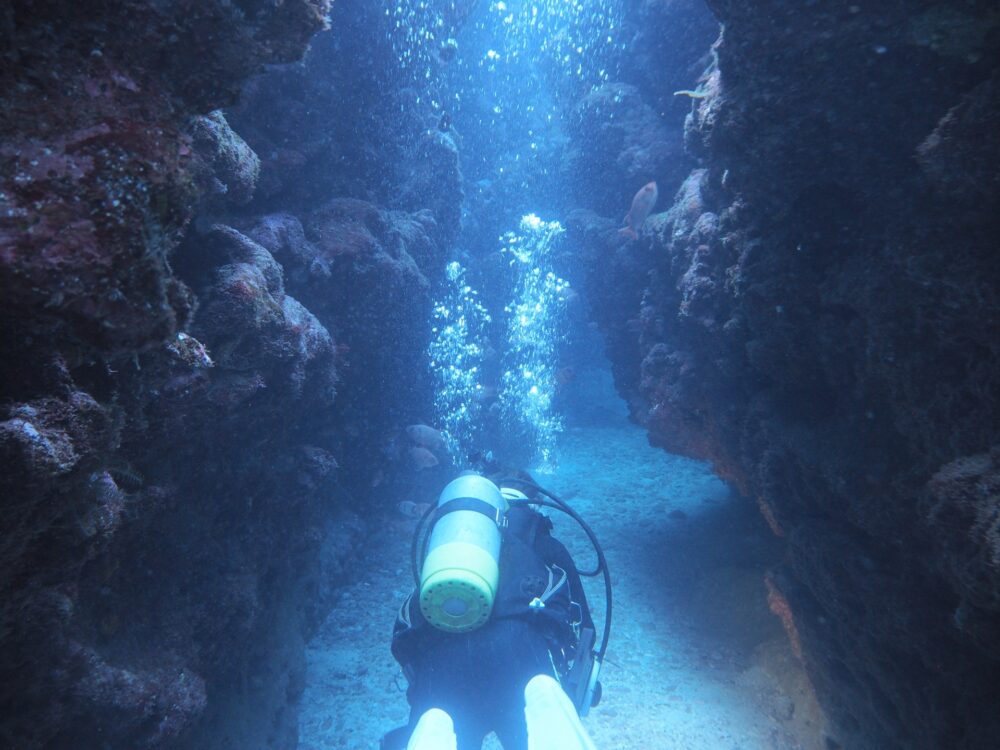
Labyrinth lives up to its name, taking you through one crevice after another.
It’s a good pick if you want to focus on terrain.
No.5 Arch
| Depth | — |
| Level | Beginner |
| Current | Rarely |
| Highlights | An arch plus a cave in the offshore rock |
At No.5 Arch you pass under an arch, then return through a cave in the offshore rock.
There are several ways to run the route, so the same site can feel different each time.
No.11 Hole
| Depth | — |
| Level | Intermediate |
| Current | Occasional |
| Highlights | A chimney known as the mini Devil’s Palace |
The main opening at No.11 Hole is narrow, but beyond it lies a chimney known as the “mini Devil’s Palace.”
Even on days when you can’t reach the real Devil’s Palace on Shimoji Island, you get something of the same feeling here.
Ingama Coral
| Depth | — |
| Level | Beginner |
| Current | Rarely |
| Highlights | A wide variety of coral |
What sets Ingama Coral apart is the sheer variety of coral.
The underwater scenery is tropical in the most classic Okinawan sense.
Hama Paradise
| Depth | Up to 7m |
| Level | Beginner |
| Current | Rarely |
| Highlights | Sand flats rich in anemonefish |
Hama Paradise is a relaxed sandy site at around 7m.
A bommie known as “Tomato Anemonefish Castle” is packed with tomato anemonefish, and other species such as white-bonnet anemonefish and clownfish are plentiful too.
Diana
| Depth | Up to 25m |
| Level | Beginner |
| Current | Rarely |
| Highlights | Vast sand flats dotted with bommies |
Diana is a site where vast sand flats open out from a shallow reef.
Bommies of all sizes dot the sand, and you dive it by moving through midwater from one to the next.
Fusiliers school around the bommies, and green sea turtles sometimes drop in.
Small World & Garden Garden
| Depth | Up to 30m |
| Level | Beginner |
| Current | Occasional |
| Highlights | Two bommies, a coral panorama |
Small World & Garden Garden is made up of two bommies.
The deeper “Small World” is thick with fish, while “Garden Garden,” covered in coral, offers a sweeping panorama.
Intermediate divers and above can cover both bommies in a single dive.
Yoshino Reef
| Depth | — |
| Level | Beginner |
| Current | Rarely |
| Highlights | A shallow reef off Yoshino Beach |
Yoshino Reef spreads offshore from Yoshino Beach, north of Higashi-Hennazaki Cape.
Yoshino Beach is known for coral that starts almost at the water’s edge, and this site lies just beyond it.
Depths and levels are not published, so check with your dive shop before booking.
Panari to Panari
| Depth | Up to 28m |
| Level | Advanced |
| Current | Ripping |
| Highlights | Schooling pelagics, manta rays if you’re lucky |
Panari to Panari lies off Higashi-Hennazaki Cape, in the east coast area around the cape.
It’s Miyako Island’s premier drift site, and is said to be the number one spot for schooling pelagics.
Dogtooth tuna, bigeye trevally, bluefin trevally, giant trevally and schools of fusiliers all show up, along with whitetip reef sharks, Napoleon wrasse and spotted eagle rays.
If you’re lucky, you may even run into a manta ray.
The current can run very hard, and dives here are usually drifts. It’s one of the few advanced sites in the area, and you need the experience to handle moving water.
Sites you can enter from the beach
Kurima Island and the south coast have four sites you can enter from land.
We cover all of them as beaches elsewhere on the site, so do take a look.
Kurima Beach
| Depth | Up to 6m |
| Level | Beginner |
| Current | Rarely |
| Highlights | Clownfish |
Kurima Beach is a shore-entry site on Kurima Island.
You can walk straight in from the breakwater steps, into a sand-and-coral site around 6m at its deepest.
Alongside clownfish you’ll find green sea turtles, broadclub cuttlefish and ornate ghost pipefish.
For the beach itself, see our article on Kurima Fishing Port Beach.
Hakuai WaiWai Beach
| Depth | Up to 5m |
| Level | Beginner |
| Current | Rarely |
| Highlights | Sea turtles |
Hakuai WaiWai Beach is a shallow beach with a large resident turtle population.
At around 5m it’s shallow enough to be used regularly for try dives and snorkeling.
For the beach itself, see our Hakuai WaiWai Beach article.
Shigira Beach
| Depth | Up to 4m |
| Level | Beginner |
| Current | Rarely |
| Highlights | Green sea turtles |
Shigira Beach is a shallow beach site at a maximum of around 4m.
Green sea turtles turn up here, and being right in front of the resort makes it very easy to access.
For the beach itself, see our Shigira Beach article.
Imgyaa Marine Garden
| Depth | Up to 7m |
| Level | Beginner |
| Current | Rarely |
| Highlights | Tomato anemonefish, calm water |
Imgyaa Marine Garden sits in an inlet cut off from the open sea.
Tomato anemonefish are abundant and the water stays calm, so it doubles as a fallback when conditions are poor.
For the beach itself, see our Imgyaa Marine Garden article.
Recommended sites for beginners
If you’ve just been certified, or it’s your first time terrain diving, these are the sites to go for.
All of them are shallow with gentle current, so you can dive them comfortably.
| Coral Garden | Up to 8m. All kinds of coral across the shallows, drawing butterflyfish and damselfish |
| Nanamata Arch | Maximum 16m. Swim through several arches in bright, shallow water |
| Angel Cave | Up to 12m. The curtain of light falling from the ceiling is the highlight |
| Shigira Beach | Up to 4m. A shore entry with a chance of green sea turtles |
| Hakuai WaiWai Beach | Up to 5m. Plenty of turtles, and often used for try dives |
Diving safely in this area
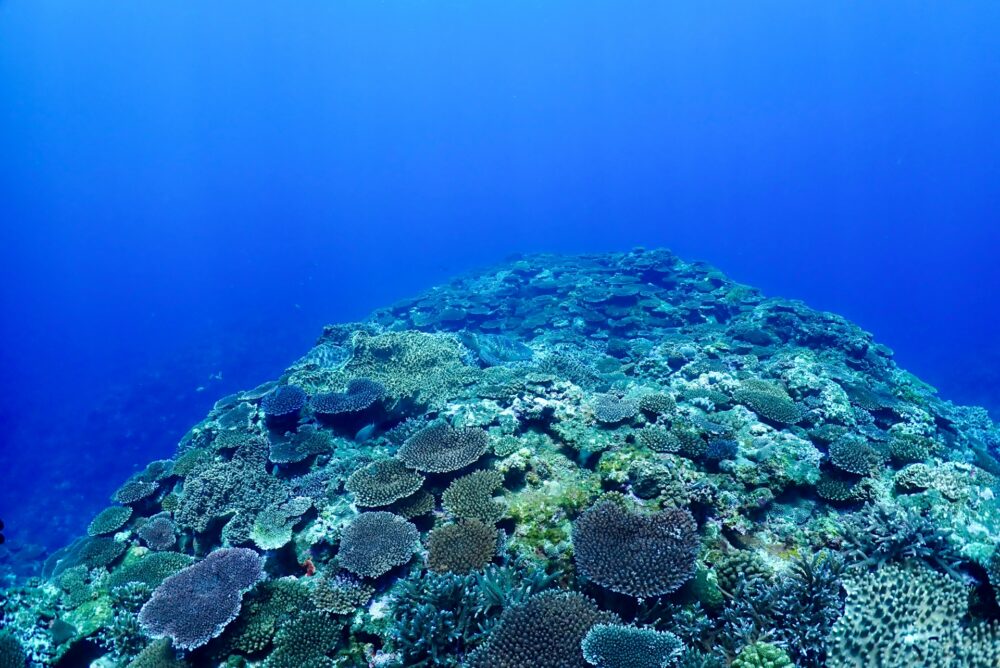
The cave at Ushisan Kowaiyo runs more than 40m. Always carry a light and go in with plenty of air in reserve.
Angel Cave is a complex, maze-like cave. Stay close to your guide.
Muiga and Gao reach 25–30m. Watch your depth and no-decompression limit.
This is an area with plenty of sites that take you into caves and arches. Unstable buoyancy can damage the terrain or wreck the visibility.
Never touch the coral. What took decades or centuries to grow can be destroyed by a single contact.
You need to leave time between diving and flying. Plan with room to spare — for example, don’t dive on the day you leave Miyako Island.
FAQ
When do people dive this area?
It’s the area you dive on rough midwinter days when strong northerlies put Irabu Island and Shimoji Island out of reach.
In other words, the more you dive Miyako Island in winter, the more likely you are to end up here.
Can beginners dive here?
There are plenty of shallow sites with gentle current, including Coral Garden, Nanamata Arch and Angel Cave.
Compared with the terrain around Irabu Island and Shimoji Island, which mostly suits intermediate divers and above, this area makes terrain diving accessible to beginners.
Can I go on a try dive?
At shallow shore-entry sites such as Kurima Beach, Hakuai WaiWai Beach and Shigira Beach, some shops accept try divers.
Cave sites like Ushisan Kowaiyo are not available on a try dive.
What happens on days when boats can’t run?
Shops may switch to the shore-entry sites.
Imgyaa Marine Garden in particular sits in an inlet cut off from the open sea, so the water stays calm and it’s often used as a fallback when conditions are poor.
Around Kurima Island and the south coast
Beaches on Kurima Island
All 5 beaches on Kurima Island covers the island’s beaches and viewpoints, including Nagama-hama and Nagasaki-hama.
There’s plenty to stop in at before or after a dive, so it’s worth a look.
Beaches in the Ueno and southern area
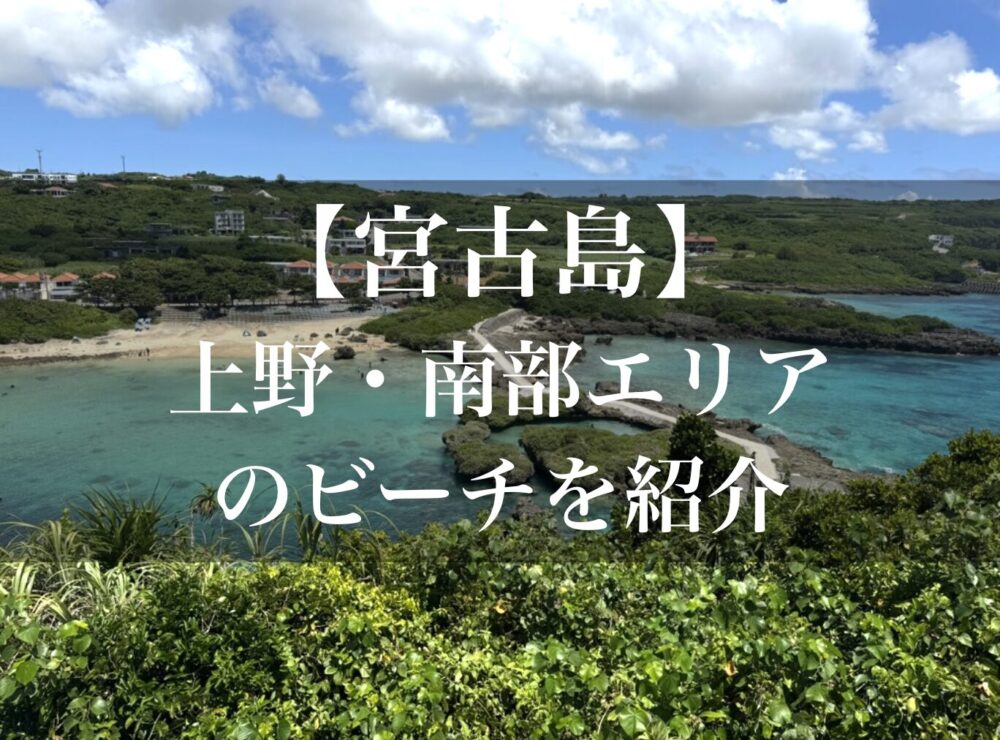
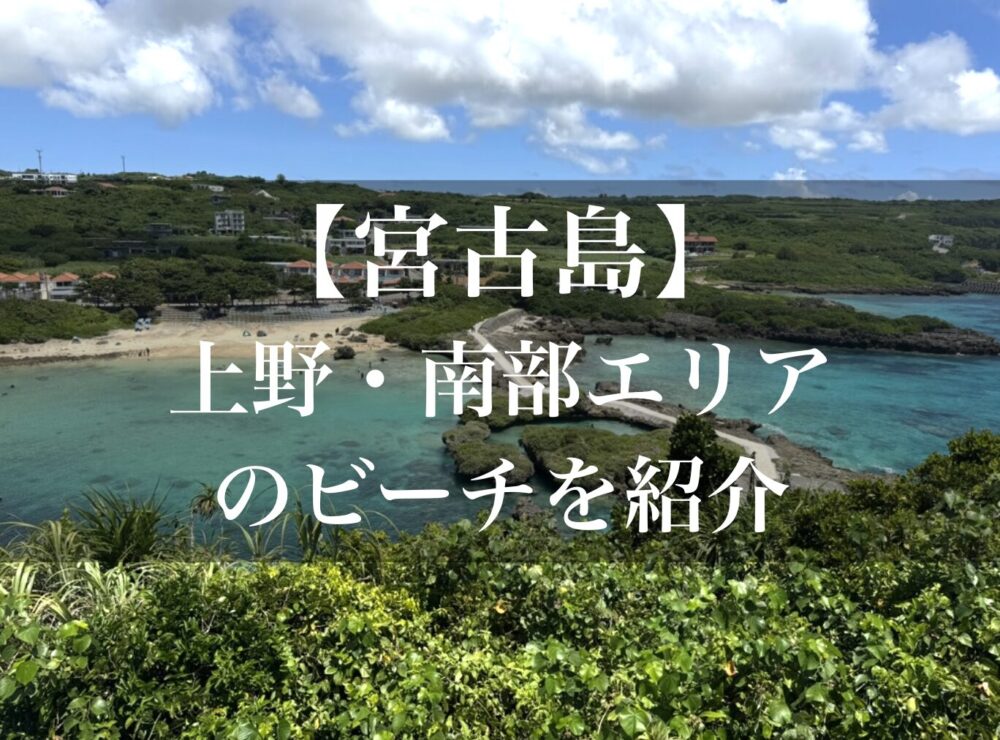
5 beaches in the Ueno and southern area brings together the south coast beaches, including Shigira Beach and Hakuai WaiWai Beach.
Activities on Miyako Island
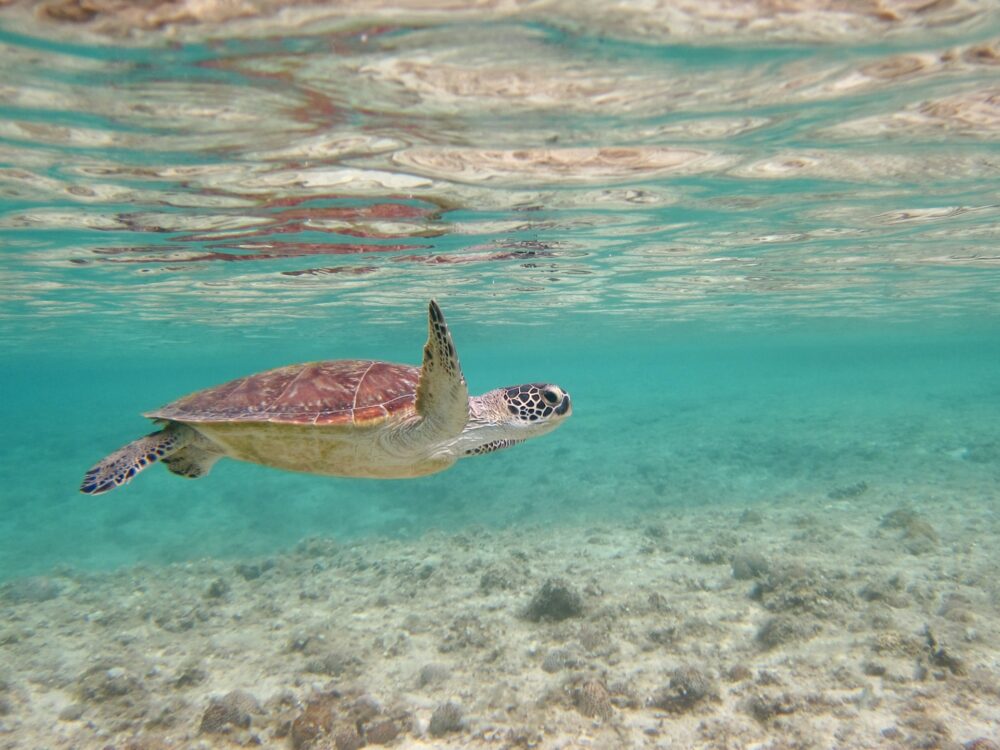
Miyako Island offers all kinds of marine activities.
Alongside fun dives and try dives, you can book snorkeling, SUP and more.
If you’re interested, take a look at what’s on offer through Viator or GetYourGuide.
Renting a car on Miyako Island
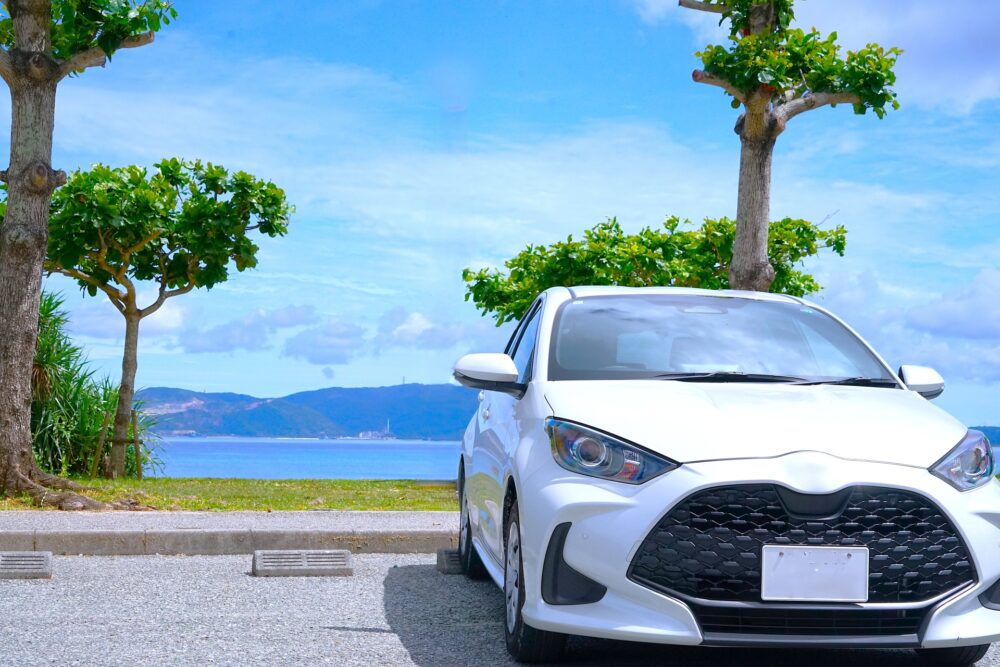
A rental car is by far the best way to get around Miyako Island.
Scenic spots such as Yonaha Maehama and Irabu Ohashi Bridge are scattered across the island, so having a car lets you explore at your own pace. With so few buses on Miyako Island, whether or not you have a car makes a real difference to the trip.
Popular seasons book up quickly, so reserve early once your dates are set.
Summary
This article covered 20 dive sites around Kurima Island and the south coast.
This is the area that comes into its own on rough midwinter days, when strong northerlies put Irabu Island and Shimoji Island out of reach.
Because the caves and arches sit in shallow water, beginners can enjoy terrain diving here — and that’s its biggest draw.
There are shore-entry sites too, so it also catches the days when boats can’t run.
If you’re planning to dive Miyako Island in winter, knowing these sites gives you more options.
Dive sites in Miyako Island’s other areas are covered together in the articles below.
Thank you for reading to the end.
Comments